

Introduction
The Used Car Market represents one of the largest and fastest-growing segments within the global automotive industry. It involves the buying and selling of pre-owned vehicles through organized dealerships, online platforms, and private transactions. As new car prices continue to rise and consumers become more price-conscious, the demand for used vehicles has surged globally. The market is driven by affordability, improved vehicle quality, digitalization, and evolving ownership models.
The market holds significant importance in both developed and emerging economies, serving as an affordable mobility solution and contributing to sustainability by extending vehicle lifecycles and reducing manufacturing-related emissions.
Learn how the Used Car Market is evolving—insights, trends, and opportunities await. Download report: https://www.databridgemarketresearch.com/reports/global-used-car-market
The Evolution
The used car market has undergone a remarkable transformation over the past two decades. Initially, it was a fragmented and informal industry dominated by local dealers and private sellers with limited trust and quality assurance. As vehicle ownership expanded globally in the 1990s and 2000s, the supply of pre-owned vehicles increased substantially.
The introduction of certified pre-owned programs by automakers such as Toyota, Ford, and BMW marked a major milestone, enhancing consumer confidence by offering warranties and vehicle inspection standards. Digital platforms emerged in the 2010s, transforming the way buyers and sellers interacted. Companies such as AutoTrader, Carvana, and CARS24 revolutionized online car trading with transparent listings, price comparisons, and home delivery services.
Technological innovations in vehicle diagnostics, data analytics, and digital documentation have brought higher efficiency and trust to the market. The rise of electric and hybrid vehicles has added a new dimension, as the used EV segment is now gaining traction among environmentally conscious consumers seeking affordability and performance.
Market Trends
1. Digitalization of Sales Channels
Online marketplaces and mobile applications have become central to the buying experience. Consumers prefer browsing, comparing, and purchasing vehicles digitally, leading to a shift from traditional dealerships to omnichannel experiences. AI-based price estimators and virtual tours are enhancing transparency and convenience.
2. Growing Popularity of Certified Pre-Owned Vehicles
CPO programs backed by automakers are gaining attention due to their reliability and warranty coverage. These programs address consumer concerns about vehicle condition, leading to higher resale values and faster turnover rates.
3. Expansion of Financing and Leasing Options
Banks, fintech firms, and OEMs are expanding financing solutions for used vehicles. Low-interest loans and flexible EMI options are increasing vehicle affordability, especially in emerging economies.
4. Rising Demand for Electric and Hybrid Used Cars
The used EV market is growing as battery technology improves and charging infrastructure expands. Consumers are increasingly choosing used EVs as they become more available and affordable, with lower maintenance costs and tax benefits.
5. Shift Toward Organized Dealerships and Online Aggregators
Organized players are capturing market share by ensuring standardization, quality assurance, and customer service. Platforms such as TrueCar, OLX Autos, and Spinny are investing in logistics, AI-based inspections, and real-time pricing tools.
Challenges
1. Lack of Standardization and Transparency
In many regions, especially developing markets, the absence of reliable vehicle history reports, odometer fraud, and inconsistent inspection practices hinder market credibility.
2. Regulatory and Tax Complexities
Diverse regulations across regions complicate trade. Import restrictions, high registration fees, and emission standards can affect used vehicle availability and pricing.
3. Economic Uncertainties and Fluctuating Demand
Macroeconomic conditions influence consumer purchasing power. Inflation, fuel price volatility, and currency fluctuations may slow market growth.
4. Supply Chain and Inventory Management
Shortages in the new car market, driven by semiconductor supply disruptions, affect the inflow of vehicles into the used segment. Managing inventory cycles and ensuring consistent quality remain critical challenges.
5. Consumer Trust and After-Sales Service
Limited warranties and inconsistent post-purchase support discourage some consumers. Building trust through transparent vehicle data and strong service networks is essential for sustained growth.
Market Scope
Segmentation by Vehicle Type
-
Passenger Cars
-
Commercial Vehicles (Light and Heavy)
-
SUVs and Crossovers
-
Electric and Hybrid Vehicles
Segmentation by Fuel Type
-
Gasoline
-
Diesel
-
Electric
-
Hybrid
Segmentation by Sales Channel
-
Organized Dealerships
-
Online Marketplaces
-
Independent Dealers
-
Private Sales
Segmentation by Propulsion
-
Internal Combustion Engine (ICE) Vehicles
-
Battery Electric Vehicles (BEVs)
-
Plug-in Hybrid Vehicles (PHEVs)
Regional Analysis
-
North America: The U.S. dominates this region with an advanced CPO network, digital sales platforms, and a high replacement rate. The market benefits from vehicle leasing and trade-in culture.
-
Europe: Strong environmental policies drive the adoption of used EVs. Germany, the UK, and France are leading in digital used car platforms.
-
Asia-Pacific: The fastest-growing market led by China and India, driven by rising disposable income, smartphone penetration, and affordability concerns.
-
Latin America: Brazil and Mexico are expanding their organized dealership networks and online presence, though informal channels still dominate.
-
Middle East & Africa: Growing automotive imports and urbanization are driving demand. Affordability and reliability are major decision factors for buyers.
End-User Industries
The used car market serves both individual and commercial customers. Ride-sharing companies, logistics operators, and small businesses rely on pre-owned vehicles for cost efficiency.
Market Size and Factors Driving Growth
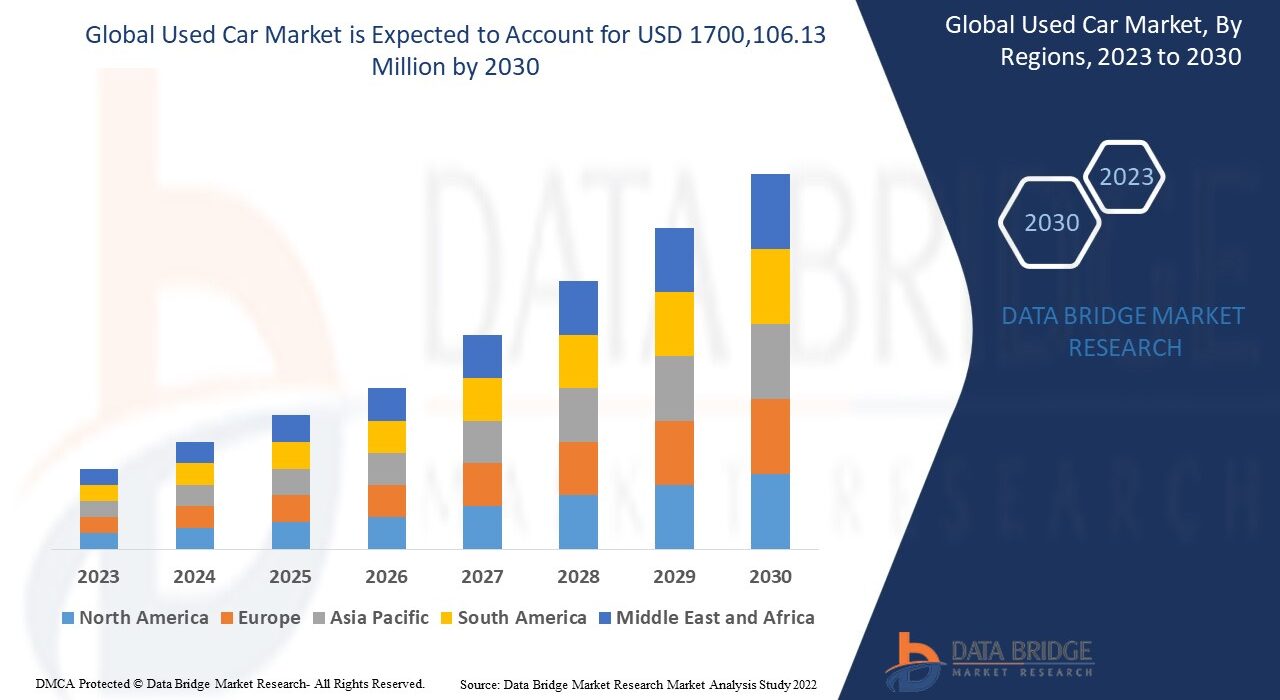
Data Bridge Market Research analyses that the global used car market was valued at USD 996,906.42 million in 2022 and is expected to reach the value of USD 1700,106.13 million by 2030, at a CAGR of 6.90% during the forecast period.
Major Drivers
1. Economic Affordability and Value for Money
Rising new car prices have made used cars a practical choice. Consumers perceive better value from pre-owned vehicles, especially as durability and reliability improve.
2. Technological Integration in Platforms
Digitalization, blockchain-based documentation, and AI-enabled pricing systems have improved transparency and accessibility, making transactions smoother and faster.
3. Increased Vehicle Lifespan and Quality
Modern vehicles are built to last longer, with better engineering and maintenance technology. This enhances resale value and buyer confidence.
4. Rising Urbanization and Shared Mobility
Growing urban populations are choosing used cars for flexibility and cost savings. Ride-hailing and shared mobility companies also contribute to fleet-based used vehicle purchases.
5. Government and Policy Support
Incentives for electric vehicles, emission control measures, and reduced registration fees for pre-owned vehicles are supporting market expansion.
6. Sustainability and Circular Economy Trends
Consumers and governments are promoting vehicle reuse and recycling, aligning the used car industry with sustainability goals by extending vehicle lifecycles.
Opportunities in Emerging Regions
Rapid urbanization and smartphone penetration in regions such as Asia-Pacific, Latin America, and Africa are unlocking vast opportunities. Online used car marketplaces are expanding rapidly, supported by growing financial inclusion and flexible payment systems.
Digital identity verification and vehicle inspection solutions are also gaining adoption, further enabling trust and convenience in emerging economies.
Conclusion
The used car market is entering a new era of growth driven by digital transformation, affordability, and sustainability. It has evolved from a fragmented, unorganized space into a structured and data-driven industry. As consumer awareness, trust, and technology adoption continue to expand, the market will witness stronger competition among traditional dealerships, OEMs, and digital startups.
Innovation in electric vehicle resale, AI-driven analytics, and financing mechanisms will shape future opportunities. Sustainability will remain at the forefront, as the circular economy concept reinforces the value of pre-owned mobility solutions. By 2035, the used car market will not only grow in size but also redefine global transportation affordability, efficiency, and accessibility.
FAQs
1. What is the current size of the used car market?
The global used car market is valued at approximately USD 1.8 trillion in 2024.
2. What is the projected growth rate of the used car market?
The market is expected to grow at a CAGR of 5.5% and reach around USD 3.2 trillion by 2035.
3. What are the major factors driving the used car market?
Key drivers include rising vehicle prices, improved vehicle durability, digital marketplaces, and increasing demand for affordable mobility.
4. Which regions dominate the used car market?
North America, Europe, and Asia-Pacific collectively hold the largest market share due to organized sales channels and strong demand.
5. How is technology influencing the used car industry?
AI-based pricing, blockchain verification, and online car sales platforms are improving transparency, trust, and customer experience.
6. What are the challenges faced by the used car market?
Challenges include lack of standardization, varying regulations, odometer fraud, and inconsistent vehicle inspection systems.
7. What opportunities exist for investors and stakeholders?
Emerging regions, used EVs, and digital trading platforms present major opportunities for new entrants and investors in the coming decade.
Browse More Reports:
Middle East and Africa Hyperloop Technology Market
North America Hyperloop Technology Market
Asia-Pacific Laboratory Information Management Systems (LIMS) Market
Europe Laboratory Information Management Systems (LIMS) Market
Middle East and Africa Laboratory Information Management Systems (LIMS) Market
North America Lithium Ion Battery Market
Asia-Pacific, Europe, South America, and Middle East and Africa Lithium Ion Battery Market
North America Metalworking Fluid Additives Market
Asia-Pacific Minimally Invasive Market
Middle East and Africa Minimally Invasive Surgery Market
Asia-Pacific Mobility as a Service Market
Middle East and Africa Mobility as a Service Market
Europe Mobility as a Service Market
North America Mobility as a Service Market
North America Oleo Chemicals Market
About Data Bridge Market Research:
An absolute way to forecast what the future holds is to comprehend the trend today!
Data Bridge Market Research set forth itself as an unconventional and neoteric market research and consulting firm with an unparalleled level of resilience and integrated approaches. We are determined to unearth the best market opportunities and foster efficient information for your business to thrive in the market. Data Bridge endeavors to provide appropriate solutions to the complex business challenges and initiates an effortless decision-making process. Data Bridge is an aftermath of sheer wisdom and experience which was formulated and framed in the year 2015 in Pune.
Contact Us:
Data Bridge Market Research
US: +1 614 591 3140
UK: +44 845 154 9652
APAC : +653 1251 975
Email:- corporatesales@databridgemarketresearch.com